How to handle the first loss in an AI bot Martingale session on Pocket Option with $500 trades
· based on the channel GPT Trading BOT | Pocket Option Auto Trading
The first loss in a one-step Martingale session is handled by doubling the stake once: on Pocket Option with $500 base trades, trade 19 lost $500 and trade 20 staked $1,100, returning +$1,012 and wiping out the loss. Part 4 of the GPT Trading BOT marathon (trades 16–20) closed with 4 wins, 1 loss and +$1,892, lifting the balance from $45,175.44 to $47,067.44. You can test the same setup with a free start via the GPT Auto Trading free trial.
What a one-step Martingale actually does on a $500 trade
A one-step Martingale means the bot is allowed exactly one recovery trade after a loss, and then it returns to the base stake. With $500 as the base amount, the sequence is fixed: any losing trade is followed by a single $1,100 deal (the $500 stake plus the $500 lost plus roughly the payout margin), and whether that deal wins or loses, the next trade goes back to $500. This is the key difference from an unlimited Martingale, where a losing streak doubles the stake again and again until either the balance or the table limit runs out. One step caps the maximum exposure of a single recovery attempt at slightly more than double the base trade, which on a $45,000+ balance is a small fraction of the account.
The first loss of the session: trade 19 and the $1,100 recovery
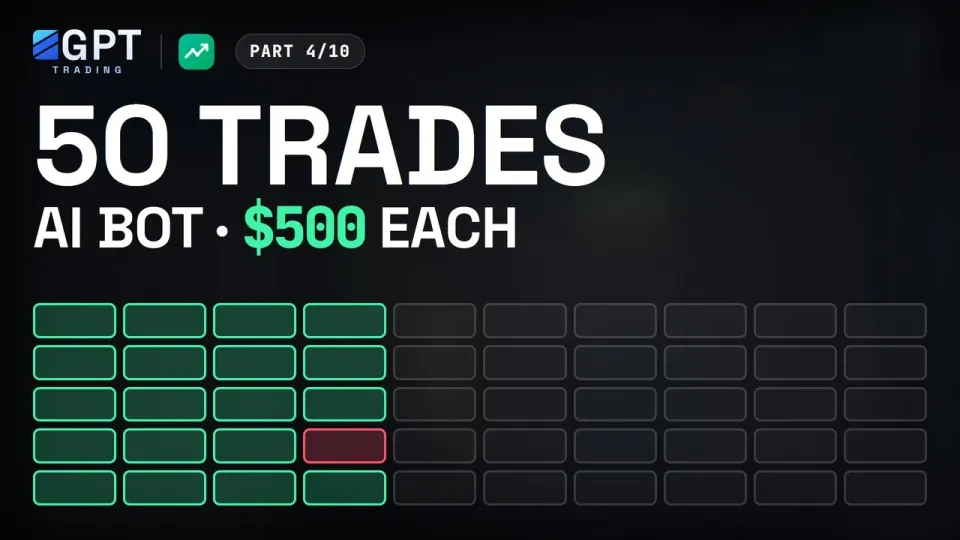
Trade 19 was the first red close of the 50-trade marathon, a −$500 result on a 30-second to 1-minute deal. The bot did not pause, did not ask for confirmation and did not change the currency pair: on the next signal it opened trade 20 with a $1,100 stake, the one Martingale step the settings allow. That trade won and paid +$1,012, so the pair of trades netted +$512. The sequence is worth noting because it shows the mechanic in isolation: one loss, one doubled stake, one recovery, then back to the $500 base. Trades 16, 17, 18 and 20 were the four wins of this part, all closed between 18:20 and 18:25.
Part 4 by the numbers
The arithmetic of this segment is simple and worth checking against your own expectations of a binary options bot. Five trades produced four wins and one loss, a 80% win rate for the part, and +$1,892 in profit. The balance went from $45,175.44 at the start of the segment to $47,067.44 at the end, and the cumulative session result reached +$8,792. The stake sizes involved were $500 on four trades and $1,100 on the Martingale step, so total turnover for the part was roughly $3,100. The whole marathon is 50 trades in a single session with no restarts, recorded in ten parts of five trades each, and earlier parts are kept in the playlist in order.
Session settings behind the trades
The configuration used in this part is the Gold preset of GPT Trading, run in Performance mode with a deal time between 30 seconds and 1 minute and automatic currency pair selection. The trade amount is fixed at $500, Martingale is limited to one step, and the session has a hard cap of 50 trades. Gold status activates automatically once the Pocket Option balance is above $300 and unlocks automated risk management and Performance mode, plus no deal limits. Setup is done from the bot interface rather than the terminal: you choose the trade mode, deal time, currency pair and amount, then tap Start Auto Session and the bot opens deals on your Pocket Option account. Everything syncs in the cloud, and the bot cannot operate without your permission.
Why one step is not the same as a Martingale spiral
The risk profile of a one-step Martingale is bounded in a way that a classic doubling sequence is not. In a spiral, four consecutive losses at a $500 base would require stakes of $500, $1,100, $2,300 and $4,700, or $8,600 of exposure to recover $500. With one step, four consecutive losses cost $500 plus $600 net on each failed recovery (the $1,100 stake returns $1,012 on a win, so a loss of the recovery trade costs the full $1,100 against a $500 base), keeping the drawdown linear rather than exponential. That does not remove risk: a losing streak still drains the account, and a binary options payout below 100% means the recovery trade must win more than it lost to break even. The mechanic only works while the win rate holds near the level seen in this session.
Links from the video and where to follow the marathon
All resources referenced in the breakdown are collected here for convenience. The main product link opens the GPT Auto Trading landing page with the free trial and the GPT100 promocode, which doubles a deposit. The Telegram channel publishes reviews and news, and the website holds the general product information.
- Free trial and GPT100 promocode: https://gpt-trading.app/landing/go?vid_6VBsYhlTI6Y
- GPT Trading Club (reviews and news): https://t.me/gpt_trading_club
- Official website: https://gpt-trading.io
What the first loss teaches about automated binary options trading
A single losing trade is not a failure of the strategy; it is the event the Martingale step exists for, and in this part it was absorbed in one move. Trade 19 lost $500, trade 20 staked $1,100 and returned +$1,012, so part 4 finished at +$1,892 with the balance at $47,067.44 and the session at +$8,792. The takeaway is to size the recovery step in advance and cap it at one, because the second and third doublings are where accounts usually break. The full 50-trade experiment was recorded by the channel GPT Trading BOT | Pocket Option Auto Trading, and you can run the same Gold settings by starting with the GPT Auto Trading free trial. Trading carries a risk of loss, and past results from a recorded session do not guarantee future performance.
Key takeaways
- Trade 19 closed in the red for −$500, the first loss of the 50-trade session.
- Trade 20 was the single Martingale step: $1,100 stake, +$1,012 profit, recovering the loss.
- Part 4 result: 4 wins, 1 loss, +$1,892 across trades 16–20.
- Balance moved from $45,175.44 to $47,067.44; the session so far stands at +$8,792.
- Settings: Gold status, Performance mode, 30s–1M deal time, $500 base stake, one-step Martingale, 50-trade limit.
Questions & answers
What happens when the bot hits its first loss with a one-step Martingale?
The bot immediately places one recovery trade at a doubled stake and then returns to the base amount. In this session trade 19 lost $500 and trade 20 was opened with $1,100, winning +$1,012 and covering the loss.
How much did part 4 of the marathon earn?
Part 4 covered trades 16 to 20 and closed with 4 wins and 1 loss for +$1,892. The balance rose from $45,175.44 to $47,067.44, bringing the session total to +$8,792.
Which settings were used for these $500 trades?
Gold status, Performance mode, a deal time of 30 seconds to 1 minute, automatic currency pair selection, a $500 trade amount, one-step Martingale and a 50-trade session limit. Gold activates automatically once the balance exceeds $300.
Is a one-step Martingale safer than an unlimited one?
It caps exposure at roughly double the base stake per recovery attempt instead of doubling repeatedly, so drawdowns grow linearly rather than exponentially. Risk is reduced but not eliminated, since a losing streak still costs money and the payout is below 100%.
Source: The First Loss: AI Bot Martingale on Pocket Option ($500 Trades) | Part 4/10 · Markdown version